Running a small business today is both exciting and challenging. While opportunities are growing faster than ever, competition is also becoming stronger in every industry. Whether you own a retail store, service business, startup, or online company, managing customer relationships has become one of the most important parts of business growth. This is exactly where CRM Setup Small Business becomes essential.
A Customer Relationship Management system, commonly called CRM, helps businesses organize customer data, track communication, manage leads, and improve sales performance. Instead of relying on spreadsheets, sticky notes, or scattered emails, a CRM gives your business a central system where every customer interaction is stored and managed efficiently.
Many small business owners assume CRM software is only for large corporations. However, that is no longer true. Today, even small businesses can benefit greatly from implementing the right CRM system. With the proper CRM Setup Small Business, companies can automate repetitive tasks, improve team collaboration, increase customer satisfaction, and generate more revenue.
Moreover, customer expectations have changed. People now expect quick responses, personalized communication, and seamless service. Businesses that fail to meet these expectations often lose customers to competitors. Therefore, adopting CRM technology is no longer optional for growth-focused companies.
This blog explores why CRM matters, how to set it up correctly, and how small businesses can use it to drive long-term success.
Why Small Businesses Need CRM More Than Ever
Small businesses often operate with limited resources. Teams are smaller, budgets are tighter, and every lead matters. Because of this, losing potential customers due to poor follow-up can directly affect revenue.
A proper CRM Setup Small Business ensures every customer inquiry is tracked from the first interaction until conversion and beyond. This helps business owners avoid missed calls, forgotten follow-ups, and lost sales opportunities.
Additionally, CRM systems help centralize valuable customer information. Instead of searching through emails or chat messages, employees can instantly access customer history, previous purchases, and communication records. As a result, service becomes faster and more personalized.
Another major advantage is visibility. Business owners can clearly see sales pipelines, pending deals, customer complaints, and conversion performance. This visibility supports better decision-making and strategic planning.
Most importantly, CRM helps businesses shift from reactive customer management to proactive relationship building. That change creates long-term customer loyalty.
Understanding What CRM Actually Does
Before planning a CRM setup for small business, it is important to understand what CRM software actually does.
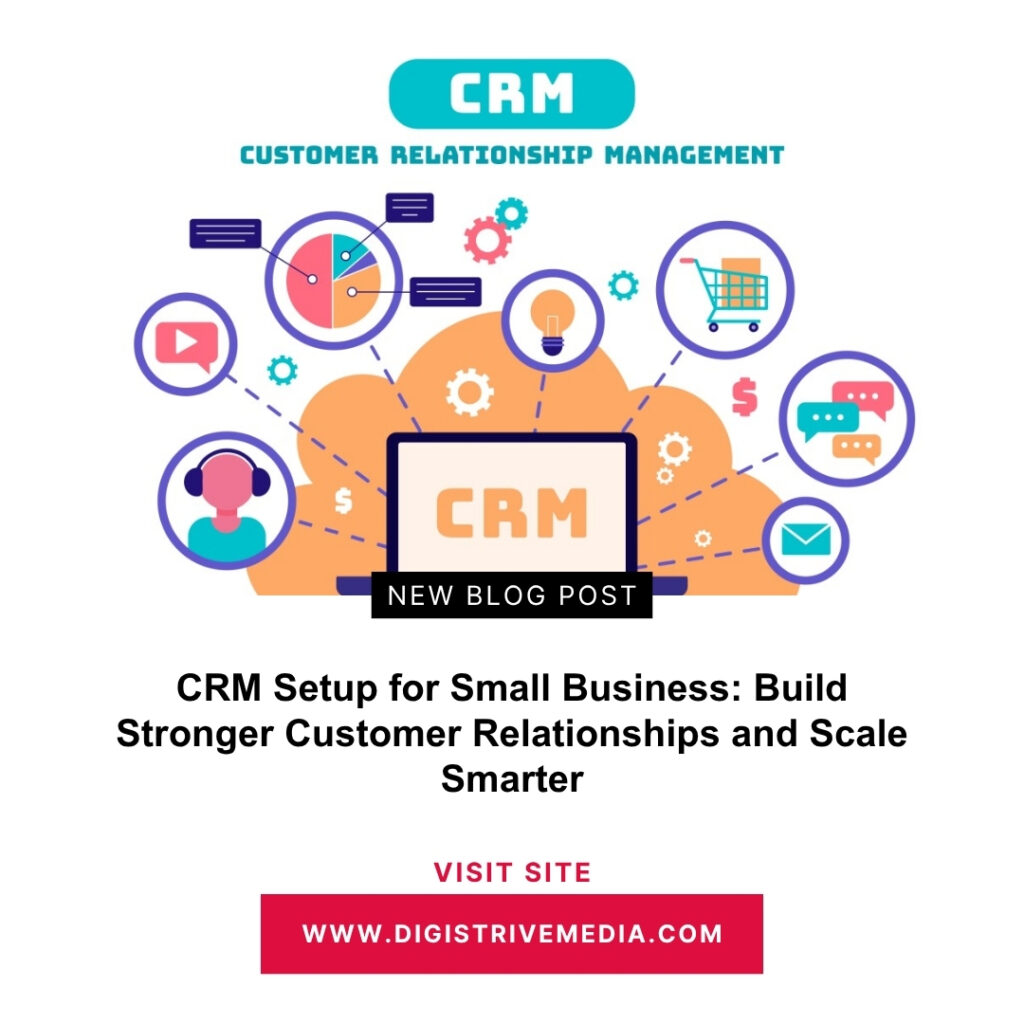
At its core, CRM collects and organizes customer information in one place. This includes names, phone numbers, email addresses, purchase history, inquiries, support requests, and communication records.
However, modern CRM platforms do much more than storing data. They automate tasks such as follow-up emails, reminders, lead scoring, appointment scheduling, and customer segmentation.
Sales teams use CRM to track leads through different stages of the sales funnel. Marketing teams use CRM to run targeted campaigns. Support teams use CRM to resolve customer issues faster.
This means CRM is not just a database. Instead, it acts as the operational backbone of customer-focused business growth.
A well-planned CRM Setup Small Business transforms raw customer data into actionable business insights. Those insights improve marketing efficiency, customer retention, and revenue generation.
Signs Your Business Needs a CRM System
Many business owners delay CRM adoption because they think their current system is working. Yet certain warning signs indicate it is time for a change.
If customer information is scattered across spreadsheets, notebooks, emails, or WhatsApp chats, you likely need CRM.
If your team forgets follow-ups or responds late to leads, CRM can solve that issue.
If you struggle to identify where leads come from or which marketing channels perform best, CRM becomes extremely valuable.
Another common issue is poor team coordination. Without a centralized system, multiple employees may contact the same lead, causing confusion and unprofessional communication.
Businesses that experience growth often face increasing operational complexity. At that stage, manual customer management becomes difficult. A reliable CRM setup for small business creates structure and scalability.
The sooner a business implements CRM, the easier future growth becomes.
Choosing the Right CRM Platform
Selecting the right platform is one of the most important parts of CRM setup for small business.
Not every CRM fits every business. Therefore, businesses must evaluate their needs before choosing software.
Start by identifying your goals. Do you need better lead tracking, sales automation, customer support management, or marketing integration?
Next, consider ease of use. A CRM should simplify operations rather than create confusion. If the system feels overly complex, adoption becomes difficult.
Budget is another critical factor. Small businesses should choose solutions that provide essential features without unnecessary enterprise-level complexity.
Integration also matters. Your CRM should connect smoothly with email platforms, websites, marketing tools, and communication systems.
Scalability should not be ignored either. A CRM that works today should also support your growth tomorrow.
Choosing carefully ensures your CRM Setup Small Business delivers long-term value.
Planning Your CRM Setup Strategy
Installing software alone does not guarantee success. Strategy matters just as much.
Before implementing CRM, define how customer data flows through your business. Map each stage from lead generation to conversion and customer retention.
Ask important questions. Where do leads originate? Who handles inquiries? How are follow-ups scheduled? What happens after a sale?
This process helps identify workflow gaps and inefficiencies.
A strong CRM Setup Small Business begins with clear business processes. Without process clarity, CRM implementation becomes messy.
Planning also helps create standardized workflows. Standardization improves consistency, reduces errors, and strengthens team accountability.
When strategy comes first, CRM becomes a powerful business engine rather than just another software tool.
Organizing Customer Data Properly
Data quality directly affects CRM performance. Poor data leads to poor decisions.
During CRM setup for small business, organize customer records carefully. Remove duplicate entries, outdated contacts, and incomplete records.
Standardize fields such as names, phone numbers, email addresses, locations, and customer categories. Consistency improves searchability and reporting accuracy.
Segment customers into meaningful groups. For example, separate new leads, active customers, repeat buyers, and inactive customers.
Segmentation helps businesses deliver targeted communication. Personalized messaging often produces better engagement and higher conversions.
Clean and structured data makes CRM more useful for daily operations.
Businesses that maintain data discipline gain stronger insights and better customer relationship management.
Automating Repetitive Tasks
Automation is one of the biggest advantages of CRM.
Small businesses often waste valuable time on repetitive manual work. Tasks like follow-up reminders, email responses, appointment confirmations, and lead assignments consume hours every week.
A proper CRM setup for small business automates these repetitive activities.
For example, CRM can automatically assign new leads to sales representatives. It can trigger welcome emails after form submissions. It can also schedule reminders for pending follow-ups.
Automation reduces human error and improves consistency.
More importantly, automation allows teams to focus on high-value activities such as sales conversations, customer support, and strategy.
Businesses that embrace automation become more productive and responsive.
Improving Sales Pipeline Management
Sales pipeline visibility is essential for growth.
Without CRM, businesses often struggle to understand where deals stand. Leads may remain untouched for weeks. Opportunities may disappear without explanation.
CRM solves this by visualizing every stage of the sales journey.
With effective CRM Setup Small Business, businesses can track prospects from initial inquiry to final purchase.
This improves forecasting because owners can estimate future revenue based on active opportunities.
Pipeline tracking also reveals bottlenecks. For instance, you may discover many leads reach proposal stage but fail during negotiation.
Identifying bottlenecks helps improve conversion strategies.
As a result, sales performance becomes easier to monitor and optimize.
Enhancing Customer Communication
Customer communication directly affects trust and loyalty.
Modern customers expect quick, relevant, and personalized responses. Delayed communication often causes frustration.
CRM improves communication by storing interaction history in one place. Employees can instantly view previous calls, emails, and support conversations.
This creates better continuity across teams.
A well-executed CRM setup for small business ensures customers never feel like they are repeating themselves.
Additionally, CRM supports personalized outreach. Businesses can send targeted offers, follow-up messages, and service reminders based on customer behavior.
Personalized communication strengthens customer relationships and improves retention.
Satisfied customers often become repeat buyers and brand advocates.
Training Your Team for CRM Adoption
Even the best CRM fails without user adoption.
Employees must understand how CRM helps their work. Otherwise, they may resist change.
Training should cover system navigation, workflow processes, data entry standards, and reporting features.
During CRM setup for small business, leadership should encourage consistent usage across departments.
Explain the benefits clearly. Show how CRM reduces workload, improves collaboration, and simplifies daily tasks.
Ongoing support also matters. Team members should feel comfortable asking questions and reporting challenges.
Successful CRM adoption depends on both technology and people.
When teams embrace CRM fully, business performance improves significantly.
Measuring CRM Performance
Implementation is only the beginning. Measuring performance ensures long-term success.
Businesses should monitor key metrics after completing CRM setup for small business.
Important metrics include lead response time, conversion rate, customer retention, sales growth, and customer satisfaction.
Tracking these metrics helps identify strengths and weaknesses.
For example, faster response times may improve conversions. Better retention may indicate stronger customer relationships.
CRM reports provide actionable insights that support continuous improvement.
Data-driven decisions help businesses adapt quickly to changing market conditions.
Regular performance analysis ensures CRM continues delivering value.
Common CRM Mistakes to Avoid
Many businesses make avoidable mistakes during implementation.
One common mistake is choosing overly complicated software. Complex systems often reduce adoption.
Another mistake is poor data migration. Importing messy data creates long-term problems.
Some businesses also skip team training, which reduces CRM effectiveness.
Ignoring customization is another issue. CRM should align with business workflows rather than forcing inefficient processes.
A poor CRM setup for small business can create frustration instead of efficiency.
Avoiding these mistakes increases implementation success.
Planning, training, and continuous optimization make a major difference.
Long-Term Benefits of CRM for Growth
CRM provides benefits far beyond daily organization.
Over time, businesses gain deeper customer insights, better retention, stronger forecasting, and improved operational efficiency.
These benefits compound as customer data grows.
A strong CRM setup for small business creates scalable infrastructure for expansion. Whether adding new employees, new locations, or new services, CRM supports structured growth.
It also improves customer lifetime value by enabling personalized engagement and better service.
Businesses that invest in customer relationships often outperform competitors.
In today’s competitive market, CRM has become a growth necessity rather than a luxury.
Conclusion
Building a successful business requires more than attracting customers. It requires managing relationships effectively, delivering consistent service, and creating systems that support sustainable growth. This is why CRM Setup Small Business has become a critical investment for modern companies.
When implemented correctly, CRM helps small businesses organize customer data, automate repetitive tasks, improve sales management, enhance communication, and make smarter decisions. Additionally, it reduces operational chaos and creates a structured path for growth.
Most importantly, CRM allows businesses to focus on what matters most—building meaningful customer relationships. In a world where customer experience often determines success, businesses that invest in CRM gain a clear competitive advantage.
Whether you are just starting out or scaling rapidly, now is the right time to implement a CRM system that supports your business goals and long-term vision.
Visit: Digistrive Media
Contact: +91 8147327494 / +91 8050732515