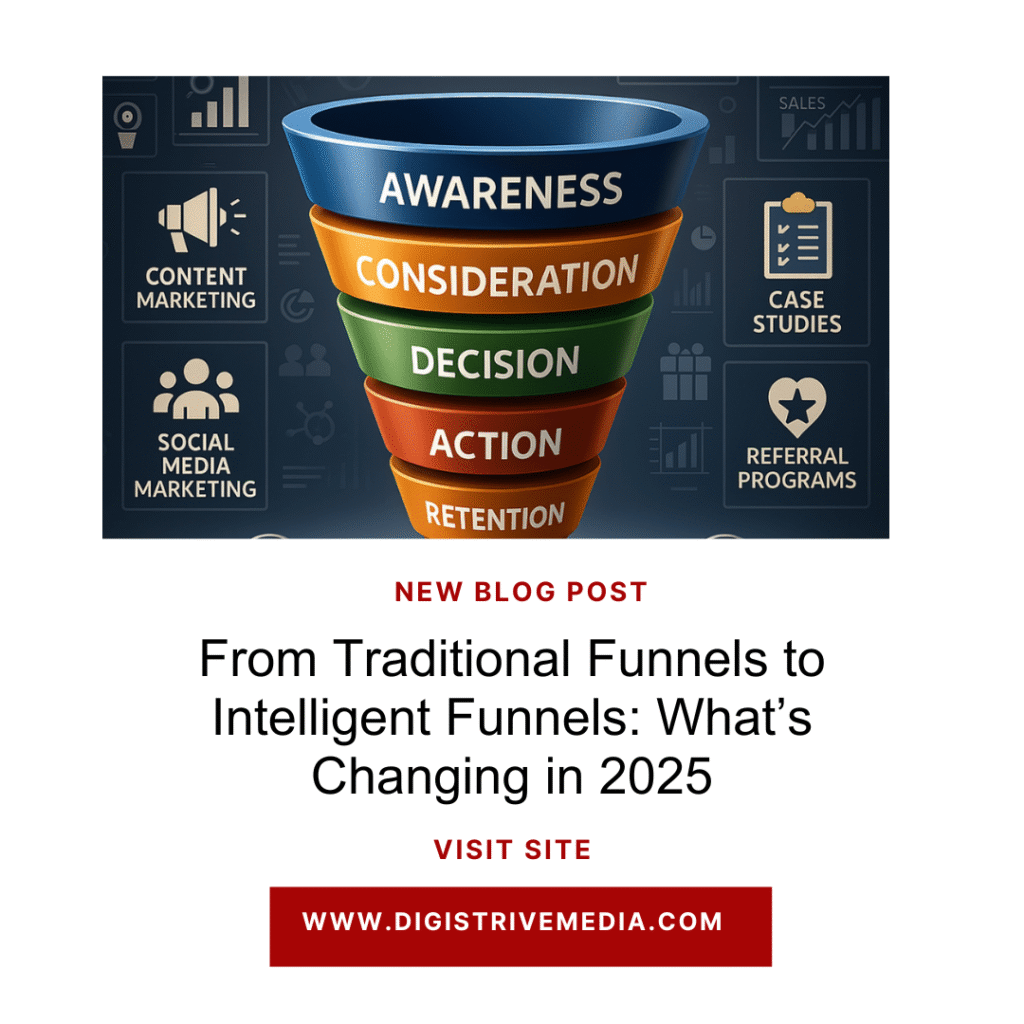
Marketing funnels have been the backbone of digital growth for more than a decade. For years, the traditional funnel followed a predictable pattern: attract visitors, capture leads, nurture them through predefined steps, and guide them toward a sale. It worked—but only to a point. Funnels were static, manual, slow to optimize, and far too generalized for the modern buyer.
Fast-forward to 2025, and the game has changed entirely. We’re entering the era of intelligent funnels—AI-powered systems that adapt in real time, respond to user behavior, and self-optimize continuously. Instead of a rigid, one-size-fits-all journey, funnels now behave more like smart ecosystems that evolve on their own.
So what exactly is changing in 2025? And why are intelligent funnels becoming essential rather than optional? Let’s break it down.
1. Funnels Are Moving From Static Steps to Dynamic Experiences
Traditional funnels operate like assembly lines. Every visitor sees the same landing page, the same form, the same follow-ups, regardless of their needs or behavior. This approach worked years ago when buyers had fewer choices and less digital noise.
In 2025, visitors expect personalized experiences instantly. Intelligent funnels adapt content, layout, and messaging based on:
- Engagement level
- Scroll depth
- Past interactions
- Traffic source
- Predicted intent
- Buyer stage
This creates a funnel that changes as the user interacts with it. No two audiences—and sometimes no two users—see the exact same journey. Instead of forcing people through a fixed pathway, the funnel molds itself around each visitor.
2. AI-Powered Behavior Prediction Replaces Guesswork
Marketers used to rely on analytics dashboards and A/B tests to identify friction points. But these methods were slow and required large amounts of traffic to produce meaningful results.
In 2025, AI predictive models analyze user signals in milliseconds and infer outcomes such as:
- Who is most likely to convert
- Who is at risk of dropping off
- What messaging resonates best
- What CTA or page layout will perform highest
- Which leads deserve priority follow-up
Rather than waiting weeks for test results, intelligent funnels optimize on the fly. AI reads micro-behaviors—like hesitation, repeated scrolling, or rapid clicking—to forecast user intent and adjust the experience in real time.
This is a massive jump from reactive marketing to proactive funnel optimization.
3. Personalization Has Evolved From Segments to Micro-Personalization
Traditional funnels relied on broad segments like “cold leads,” “warm leads,” or “buyers.” While segmentation was better than nothing, it oversimplified user behavior.
In 2025, intelligent funnels use micro-personalization, which adjusts content based on:
- Individual browsing patterns
- Device type
- Location or demographic data
- Emotional tone of interactions
- Content consumed
- Predicted interests
A visitor who shows high purchase intent may see:
- A shorter checkout
- A limited-time offer
- A simplified form
- Urgency-based messaging
Meanwhile, a visitor still researching may receive:
- A comparison chart
- A video walkthrough
- A chatbot offering guidance
Every step is tailored—not just every segment.
4. Automation Is Evolving Into Autonomous Optimization
Automation has been around for years: automated emails, scheduled SMS, chatbots, and retargeting sequences. But traditional automation was rule-based and limited. If a user did X, the system sent Y. It was predictable and inflexible.
In 2025, intelligent funnels introduce autonomous optimization, where systems:
- Detect friction
- Diagnose the cause
- Deploy improvements
- Test variations automatically
- Keep what works
- Delete or adjust what doesn’t
Without human intervention.
For example, if the AI sees that 30% of mobile users drop off at a form field, it might shorten the form for mobile visitors instantly. If a headline underperforms for one audience group, AI rewrites it and pushes the winning version live.
In other words, the funnel becomes a self-improving organism.
5. Voice AI & Conversational Funnels Are Taking Center Stage
Traditional funnels rely on text-based interactions—landing pages, forms, and emails. But 2025 is seeing a huge rise in voice AI, allowing funnels to include:
- AI voice lead qualification
- Voice follow-ups
- Smart outbound calls
- Appointment setting
- Conversational selling
- Human-like responses in real time
This closes gaps that traditional funnels couldn’t address. A dropped lead can receive an AI voice callback within seconds. Visitors stuck on a checkout page can receive instant assistance.
These voice-driven funnels increase engagement while reducing manual labor for sales teams.
6. Data Integration Creates a Single, Unified Customer View
Before intelligent funnels, data was scattered across tools:
- CRM
- Email marketing
- Landing page builders
- Sales call platforms
- Ads manager
- Analytics dashboards
This fragmentation slowed decisions and made optimization nearly impossible.
In 2025, intelligent funnels integrate data automatically, creating a unified customer profile. The system sees everything—from first click to final purchase, including calls, emails, chats, and pages visited. AI uses this complete dataset to guide the next best step for each lead.
This “single source of truth” makes funnels smarter, faster, and more profitable.
7. What This Means for Businesses in 2025
Businesses adopting intelligent funnels enjoy:
- Higher conversion rates due to personalized journeys
- Lower ad costs thanks to smarter traffic allocation
- Better user experience through adaptive design
- More qualified leads because of AI-driven scoring
- Faster decisions with unified data
- 24/7 engagement using AI voice and chat systems
In short, intelligent funnels don’t just improve performance—they multiply results.