The FOMO Effect — How Scarcity and Urgency Boost Conversions in Digital Marketing
Discover the psychology behind FOMO marketing. Learn how scarcity and urgency trigger buying behavior and how top brands use these tactics to drive conversions.
FOMO marketing psychology
/fomo-marketing-psychology
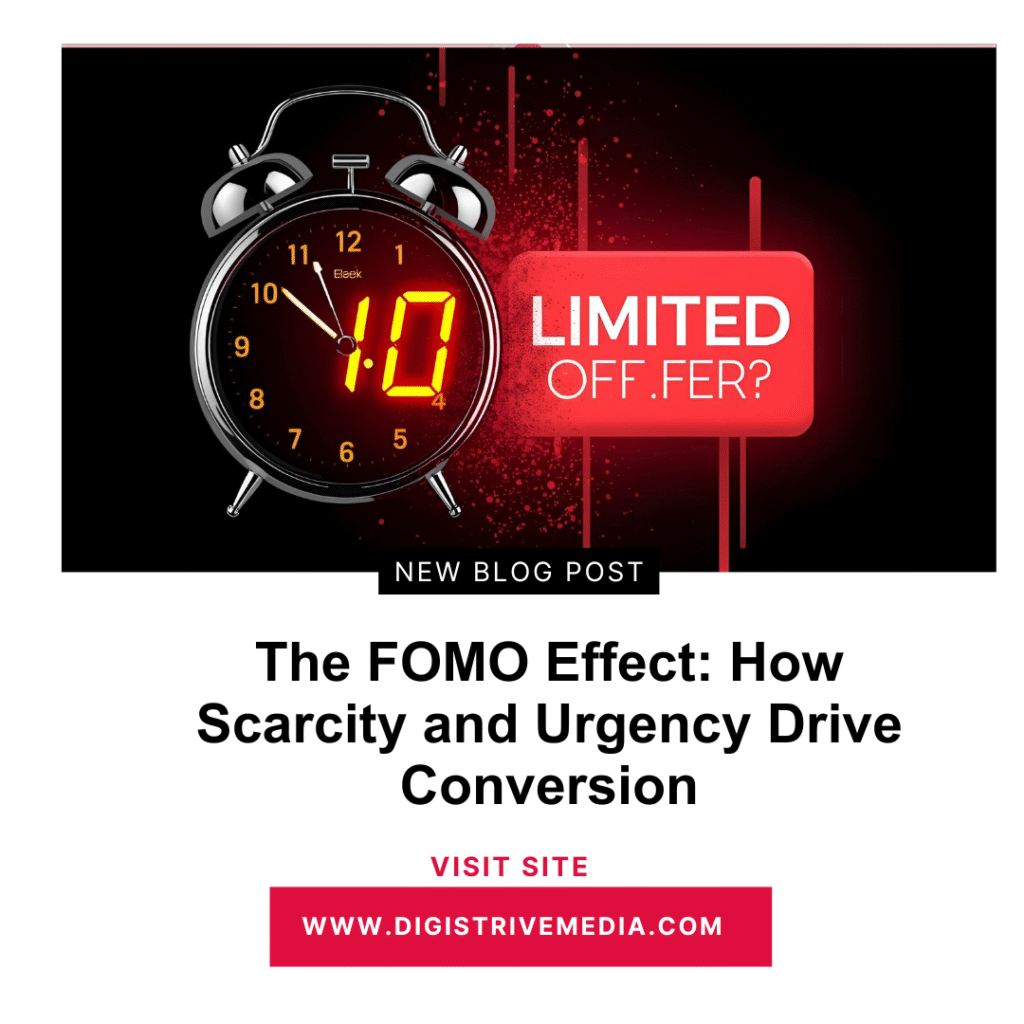
A digital countdown clock beside a “Limited Offer” button representing urgency and scarcity in marketing psychology.
🧠 Introduction: The Fear That Sells
Why do people rush to buy concert tickets, join flash sales, or grab “Only 3 Left!” offers?
Because the fear of missing out (FOMO) triggers a powerful emotional response:
“If I don’t act now, I’ll lose something valuable.”
In psychology, this comes from loss aversion — people feel the pain of missing out twice as strongly as the joy of gaining something.
Smart marketers use FOMO marketing psychology to nudge people into acting now rather than “maybe later.” When used ethically, it doesn’t pressure — it inspires urgency and excitement.
⚙️ 1. What Exactly Is FOMO Marketing?
FOMO (Fear of Missing Out) marketing is the strategy of using scarcity (limited quantity) and urgency (limited time) to encourage instant decisions.
It works because it triggers three deep human instincts:
- 🧩 The Desire to Belong — “Everyone else is doing it, I should too.”
- ⚡ The Need to Avoid Loss — “I can’t miss this opportunity.”
- ⏱ The Urge to Act Fast — “If I wait, it’ll be gone.”
When done right, FOMO marketing psychology doesn’t feel manipulative — it feels important and exclusive.
⏰ 2. The Psychology Behind FOMO
Two primary psychological triggers power the FOMO effect:
🧠 1. Loss Aversion (Daniel Kahneman, Nobel Prize Winner)
Humans fear loss more than they value gain.
“Only 3 spots left” sounds more urgent than “Join our course now.”
👥 2. Social Proof
People trust what others already choose.
“Over 10,000 marketers joined this program” adds reassurance and social validation.
These triggers activate our reward centers — releasing dopamine and pushing us to act fast.
💣 3. The Science of Scarcity and Urgency
| Trigger Type | Description | Example |
|---|---|---|
| Scarcity | Limited supply increases perceived value | “Only 5 seats left!” |
| Urgency | Time constraint accelerates decision-making | “Offer ends in 2 hours!” |
| Social FOMO | Community participation creates belonging | “Join 2,000+ members inside!” |
| Event-Based | One-time exclusivity | “Tickets available till Sunday only!” |
Scarcity + urgency create a psychological countdown — the brain feels time pressure → dopamine spikes → quick decisions follow.
🧩 4. Real Brand Examples Using FOMO Psychology
- 🛒 Amazon Lightning Deals: Shows “X% claimed” with timers — pure urgency.
- 🎟️ Spotify Premium: “Offer ends soon” drives upgrade decisions.
- 👟 Nike Drops: Exclusive product launches create scarcity-driven hype.
- 🏨 Booking.com: “Only 2 rooms left” + “Someone just booked this” = perfect social proof + urgency combo.
These brands use visual urgency and emotional scarcity to drive massive engagement and conversions.
🔥 5. How to Use FOMO in Digital Marketing Campaigns
Here’s how to apply FOMO marketing psychology effectively across channels:
1️⃣ Limited-Time Offers
→ Use countdowns: “Today Only,” “Ends at Midnight,” “Final Call.”
2️⃣ Limited Quantity
→ Mention stock numbers: “Only 10 left in stock!”
3️⃣ Exclusive Access
→ Create members-only or early-bird deals for insiders.
4️⃣ Live Social Proof
→ Use dynamic notifications like “John from New York just purchased!”
5️⃣ Early Rewards
→ Offer incentives for quick action: “First 100 users get 20% off.”
Each tactic blends loss aversion with status motivation — prompting immediate clicks.
🧠 6. Emotional Words That Trigger FOMO
The right words can spark instant urgency and curiosity.
| Category | Power Words |
|---|---|
| ⏰ Time Pressure | Now, Hurry, Today, Ends Soon, Limited Time |
| 💸 Scarcity | Few Left, Exclusive, Rare, Limited |
| 👥 Community | Join Others, Trending, Most Popular |
| ❌ Loss | Don’t Miss Out, Final Chance, Gone Forever |
Example headline:
“Final 24 Hours: Grab Your Spot in the Marketing Masterclass (98% Full)”
💡 It combines time pressure, community, and loss — the perfect FOMO trifecta.
🧩 7. Visual Psychology of FOMO
Design plays a crucial role in amplifying urgency and scarcity.
| Visual Element | Effect on Brain |
|---|---|
| ⏱ Countdown Timers | Creates visual time pressure |
| 🔴 Red/Orange Buttons | Triggers urgency and excitement |
| ⚡ Alert Icons | Capture attention instantly |
| 📉 Progress Bars | Show movement and social activity |
🧠 Pro Tip: Combine movement + contrast + time cues. It keeps the brain alert and ready to act.
📊 8. FOMO in Email and Social Media Marketing
| Channel | Tactic | Example |
|---|---|---|
| Time-bound subject lines | “⏰ Only 6 Hours Left to Save 30%” | |
| Instagram Stories | 24-hour urgency | “Offer ends when the story disappears” |
| Facebook Ads | Countdown visuals | “Sale ends tonight!” |
| LinkedIn Posts | Social validation | “Only 20 seats left for our workshop!” |
💬 Why it works:
Social visibility amplifies FOMO — nobody wants to be the last to act or the one left behind.
⚖️ 9. Ethical Use of FOMO Marketing
⚠️ Misusing FOMO destroys trust.
Always keep scarcity and urgency real.
✅ Best Practices:
- Be transparent — never fake stock or time limits.
- Pair urgency with value — explain why it matters.
- Honor deadlines — remove expired offers on time.
Ethical FOMO = motivation.
Fake FOMO = manipulation.
Build trust by using urgency responsibly.
✅ Conclusion: From Fear to Action
FOMO marketing psychology isn’t about fear — it’s about focus.
It transforms hesitation into energy, helping customers act before opportunity passes.
When people think,
“If I wait, I’ll miss something valuable,”
they move from curiosity → decision → action.
💬 The best brands don’t create panic — they create anticipation.
Design offers that make people want to join, not just buy.
Because true FOMO isn’t about loss — it’s about belonging. ⚡
🔗 Internal Cluster Links
- The Psychology of Digital Marketing: Why People Click, Buy, and Share
- The Psychology of Click-Worthy Headlines — How Curiosity Triggers Attention
- Emotional Marketing: How to Make Customers Feel Before They Buy
- The Psychology of Trust in Digital Branding
🧠 Quick Learning Recap
By mastering FOMO marketing psychology, you’ve learned:
✅ The science behind scarcity and urgency
✅ Real-world brand examples from Amazon, Nike, and Booking.com
✅ Emotional and visual triggers that drive conversions
✅ How to apply FOMO ethically for long-term trust and ROI
Use these insights to create campaigns that people can’t resist clicking — not out of fear, but because they’re excited to belong.
External Source:
Learn more about behavioral FOMO from Neil Patel: The Psychology of FOMO in Marketing