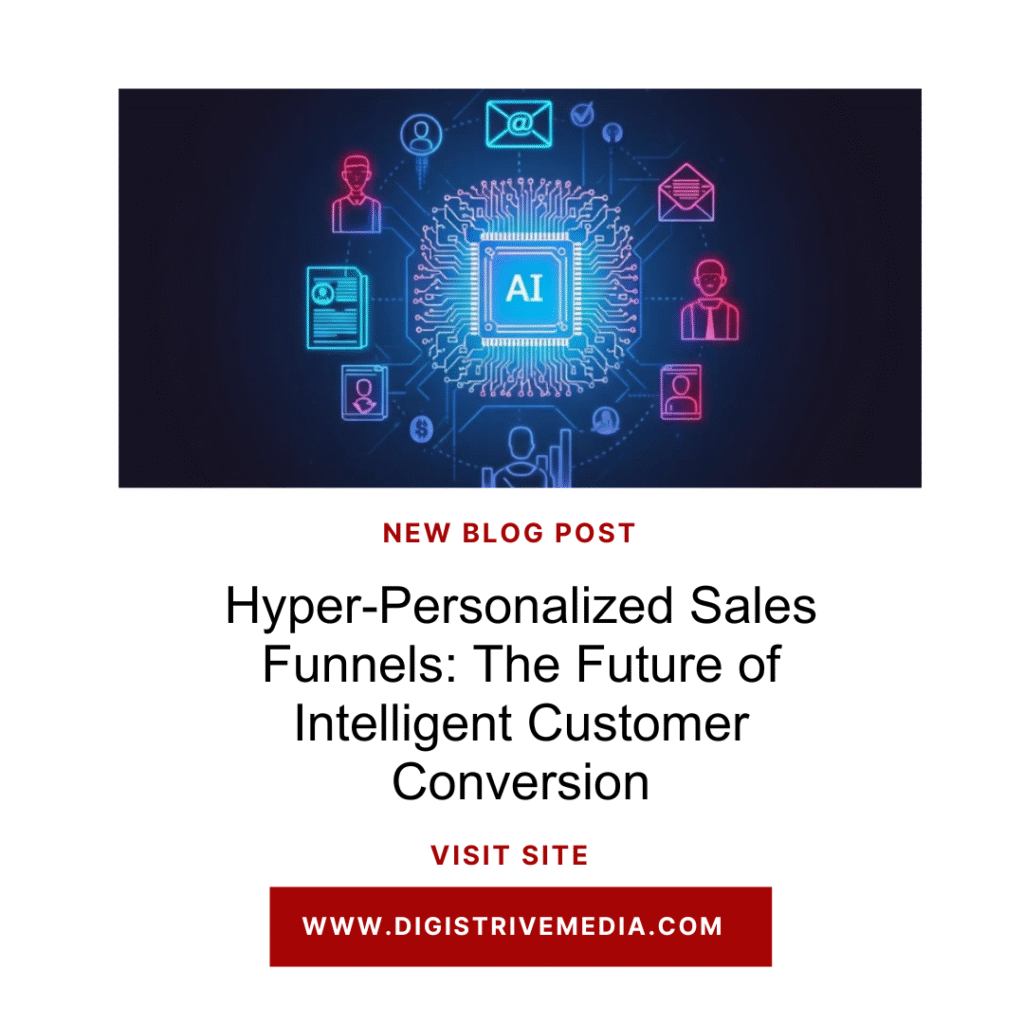
Hyper-Personalized Sales Funnels: The Future of Intelligent Customer Conversion
In today’s digital landscape, businesses can no longer rely on one-size-fits-all marketing. Customers expect relevance — they want brands to understand their needs, anticipate their desires, and deliver seamless, personal experiences across every touchpoint. This shift has given rise to hyper-personalized sales funnels, where artificial intelligence (AI) and data analytics work together to tailor every stage of the customer journey.
Hyper-personalization isn’t just another buzzword. It’s rapidly becoming the foundation of modern marketing and sales strategies — and for good reason. According to McKinsey, companies that excel at personalization generate 40% more revenue from those activities than average players. Let’s explore how AI is reshaping sales funnels, why it matters, and how businesses can leverage it for long-term success.
From Traditional Funnels to AI-Driven Personalization
A traditional sales funnel guides a potential customer through stages — awareness, interest, decision, and action — using the same content and offers for everyone. It’s structured and predictable, but also rigid.
Today’s consumers, however, interact with brands across multiple channels — websites, emails, chatbots, social media, and even voice assistants. They expect consistency and relevance across them all. AI enables businesses to evolve beyond static funnels into dynamic, hyper-personalized experiences that adjust in real time based on user data and behavior.
With AI, a sales funnel can:
- Analyze browsing history, engagement patterns, and demographic data.
- Predict what content, offer, or product a user is most likely to engage with next.
- Deliver that content automatically at the optimal time and through the best channel.
The Anatomy of a Hyper-Personalized Funnel
A hyper-personalized sales funnel uses machine learning, predictive analytics, and automation to refine each stage. Here’s how it looks in practice:
1. Awareness: Intelligent Targeting
At the top of the funnel, AI enhances targeting by analyzing user intent signals from search queries, social media behavior, and online activity.
For example, an AI-powered ad platform might identify a segment of users showing high interest in sustainable fashion. It then delivers personalized ad creatives emphasizing eco-friendly materials and ethical sourcing, maximizing engagement and click-through rates.
2. Interest: Tailored Content Delivery
Once users engage, AI tools like recommendation engines personalize the website experience. Visitors see customized landing pages, blog suggestions, or product recommendations aligned with their interests.
Email campaigns can also adapt dynamically. Instead of sending the same newsletter to all subscribers, AI systems analyze engagement history and craft unique versions — adjusting subject lines, images, and calls-to-action for each recipient.
3. Decision: Predictive Nurturing
AI-driven lead scoring helps sales teams prioritize the most promising prospects. Predictive models assess which leads are most likely to convert based on past interactions, demographics, and even sentiment analysis from chat conversations.
Chatbots and conversational AI can also assist by providing instant, context-aware responses — nurturing leads around the clock and guiding them toward the next step in the funnel.
4. Action: Real-Time Conversion Optimization
At the conversion stage, AI monitors user behavior to identify friction points — such as hesitation at checkout or confusion about pricing.
Systems like Hotjar or Google Optimize use machine learning to test variations automatically, helping marketers refine page layouts, CTAs, and copy in real time.
Why Hyper-Personalization Works
The success of hyper-personalized funnels lies in data-driven empathy — the ability to treat every customer as a unique individual, not a statistic. When users feel understood, they engage more deeply and trust the brand more.
Key benefits include:
- Higher conversion rates: Personalized offers can increase conversion rates by up to 300%.
- Improved customer retention: AI-driven personalization fosters loyalty by consistently meeting customer needs.
- Efficient resource allocation: Sales and marketing teams can focus on high-probability leads, reducing wasted effort.
- Continuous optimization: AI learns from each interaction, ensuring the funnel gets smarter over time.
Ethical and Practical Considerations
While the potential is enormous, hyper-personalization also brings challenges — particularly around data privacy and transparency. Consumers are increasingly wary of how their data is used. Regulations like GDPR and CCPA require businesses to handle personal data responsibly and disclose how it influences decision-making.
To build trust, companies must prioritize:
- Data transparency: Clearly explain how customer data is collected and used.
- Consent management: Allow users to opt in and control their personalization preferences.
- Human oversight: Maintain a balance between automation and genuine human interaction.
How to Implement a Hyper-Personalized Funnel
Getting started doesn’t require an overnight transformation. Here’s a roadmap:
- Audit your data ecosystem: Identify what customer data you already have and what’s missing.
- Leverage AI tools: Use platforms like HubSpot, Salesforce Einstein, or Adobe Experience Cloud to automate personalization.
- Start small: Test personalization on one channel (e.g., email) before expanding to your full funnel.
- Monitor and refine: Continuously measure performance and adjust based on AI-driven insights.
The Future of Sales Funnels
As AI technology advances, sales funnels will become even more intuitive — anticipating customer needs before they’re even expressed. Imagine a funnel that adapts in real time, offering product demos, discounts, or reminders precisely when a customer is most receptive.
In the near future, we’ll see the rise of autonomous funnels — systems that self-optimize, learn from customer sentiment, and orchestrate personalized journeys across all touchpoints without human intervention.
Final Thoughts
Hyper-personalized sales funnels are more than a marketing innovation — they’re a strategic imperative. In a world where attention is scarce and competition is fierce, businesses that use AI to craft truly individualized customer journeys will stand out, build stronger relationships, and convert faster.
The future of marketing isn’t just automated — it’s intelligently human.