In today’s fast-moving digital economy, managing business finances manually can slow growth and create costly mistakes. Whether you run a startup, retail shop, service company, or enterprise-level organization, billing remains one of the most critical processes in daily operations. However, traditional invoicing methods often involve repetitive data entry, delayed payments, calculation errors, and poor financial tracking. These challenges can affect cash flow, customer satisfaction, and overall business efficiency. This is where Automated Billing Software Solutions becomes a game changer. Businesses now rely on intelligent billing systems to simplify invoicing, automate recurring payments, track transactions, generate reports, and reduce manual workload. Instead of spending hours creating invoices and checking payment records, organizations can automate these tasks and focus on growth-driven activities.
Moreover, modern billing tools integrate with accounting systems, payment gateways, CRM platforms, and tax compliance frameworks. As a result, businesses gain better financial visibility and stronger operational control. With rising customer expectations and growing competition, adopting automated billing software is no longer optional for businesses that aim to scale efficiently.
This blog explores how automated billing software works, why businesses need it, its core features, benefits, and how choosing the right solution can transform financial operations.
Why Businesses Are Moving Toward Automated Billing Software Solutions
Businesses across industries are rapidly shifting from manual invoicing to Automated Billing Software Solutions. The reason is simple: automation saves time and reduces errors. Manual billing processes often require employees to create invoices individually, calculate taxes, update payment records, and send reminders manually. This workflow consumes valuable resources.
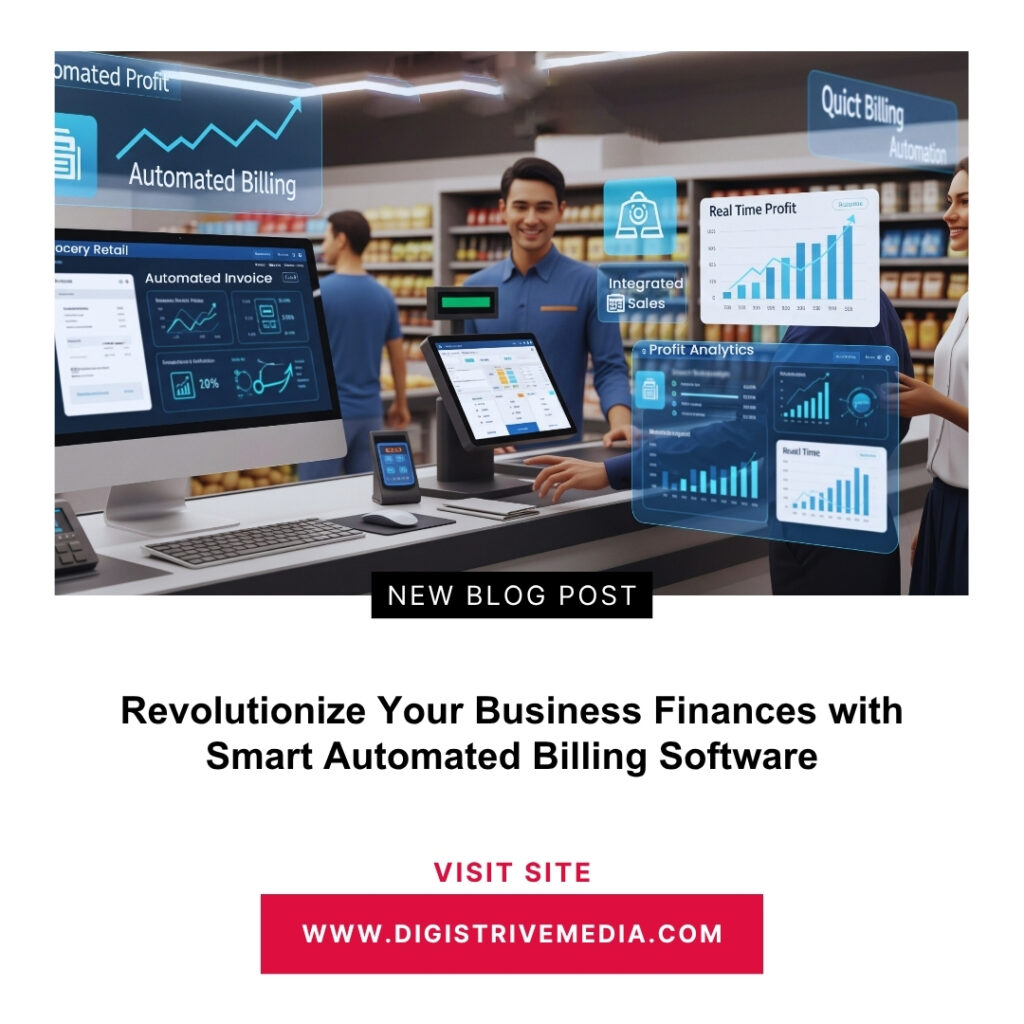
Automated billing software streamlines every step of the billing cycle. Once configured, the software automatically generates invoices, applies taxes, sends payment reminders, and updates payment status in real time. Consequently, teams no longer need to manage repetitive administrative tasks.
In addition, digital transformation has increased customer expectations. Clients now prefer quick invoices, multiple payment methods, instant confirmations, and transparent billing records. Automated solutions help businesses deliver this seamless experience. They also improve internal coordination between finance, sales, and customer service departments.
As businesses scale, billing complexity increases. Subscription plans, recurring charges, discounts, tax rules, and multiple payment cycles can become difficult to manage manually. Therefore, automation helps organizations maintain consistency while supporting growth.
How Automated Billing Software Works
Automated Billing Software Solutions functions by digitizing and automating invoice-related tasks. The software collects customer data, billing details, payment terms, tax structures, and service records in a centralized system. Based on predefined rules, it generates invoices automatically.
For recurring business models such as SaaS, telecom, utilities, or memberships, the software schedules recurring invoices based on billing cycles. It can charge customers monthly, quarterly, or annually without manual intervention.
When payments are received, the system updates records instantly. Some platforms also send overdue reminders and payment confirmations automatically. Because of this, businesses can reduce delayed collections and improve cash flow.
Most automated billing software includes dashboards and analytics tools. These features provide insights into revenue trends, unpaid invoices, customer payment behavior, and profit margins. This financial visibility enables better business decisions and strategic planning.
Reducing Human Errors in Financial Operations
Human error is one of the biggest risks in manual billing systems. Small mistakes in calculations, tax entries, customer details, or payment records can lead to revenue loss and compliance issues. Incorrect invoices can also damage customer trust.
Automated billing software minimizes these risks significantly. Since calculations are system-generated, there is little room for mathematical mistakes. Tax percentages, discounts, and service charges are applied consistently according to predefined settings.
Additionally, automation reduces duplicate billing and missing invoices. Every transaction gets recorded systematically, creating a clear audit trail. This improves transparency and accountability across financial operations.
When businesses eliminate frequent billing errors, customer disputes also decline. As a result, teams spend less time resolving payment conflicts and more time focusing on service quality.
Improving Cash Flow Management
Cash flow determines the financial health of any business. Delayed payments, missed invoices, and poor tracking often create cash shortages. Businesses struggling with irregular payments may face operational challenges.
Automated Billing Software Solutions improves cash flow by ensuring invoices are generated and delivered on time. Since reminders are automated, customers receive regular notifications before due dates. This increases payment consistency.
Furthermore, integrated payment gateways allow customers to pay instantly through cards, UPI, wallets, or bank transfers. Faster payments directly improve liquidity and reduce outstanding receivables.
Businesses also gain access to payment forecasts and revenue reports. These insights help finance teams plan expenses, investments, and expansion more effectively. Better cash flow management ultimately strengthens business stability.
Enhancing Customer Experience Through Faster Billing
Customer satisfaction depends heavily on smooth service interactions. Billing is often the final touchpoint in a customer journey, making it essential for building trust. Slow or inaccurate billing can frustrate customers.
Automated billing software improves customer experience by delivering accurate invoices quickly. Customers receive clear billing breakdowns, payment links, and automated confirmations. This creates transparency and convenience.
Additionally, self-service portals offered by advanced billing systems allow customers to view invoices, payment history, subscriptions, and receipts anytime. Such accessibility improves customer confidence.
When billing becomes fast and reliable, businesses create stronger relationships with customers. Happy customers are more likely to return and recommend services to others.
Managing Recurring Payments with Ease
Many modern businesses operate on subscription-based revenue models. Examples include software services, online learning platforms, gyms, memberships, and maintenance services. Managing recurring billing manually becomes difficult as customer volume increases.
Automated billing software handles recurring payments effortlessly. Businesses can define billing schedules, renewal periods, pricing tiers, and trial periods. Once configured, invoices are generated automatically.
The software can also handle upgrades, downgrades, prorated charges, and renewals. This flexibility is especially useful for subscription businesses with dynamic pricing structures.
Because recurring billing becomes automated, businesses reduce churn caused by missed renewals or billing confusion. Consistent billing creates predictable revenue streams.
Better Tax Compliance and Regulatory Support
Tax regulations continue to evolve, making compliance more challenging for businesses. Incorrect tax calculations can result in penalties, audits, and legal complications. Manual systems often struggle to keep pace with regulatory changes.
Automated Billing Software Solutions helps businesses remain compliant by applying updated tax rules automatically. GST, VAT, service taxes, and region-specific tax requirements can be configured within the system.
Additionally, billing software generates detailed financial reports required for audits and tax filing. This reduces compliance burden and improves documentation accuracy.
Since records are digitally stored, businesses can retrieve historical billing data instantly whenever needed. This strengthens financial governance and regulatory preparedness.
Real-Time Reporting for Smarter Decisions
Data-driven decision-making has become essential for business growth. Without proper financial reporting, companies may struggle to identify revenue trends or inefficiencies.
Automated billing software provides real-time analytics dashboards. These dashboards display revenue growth, outstanding invoices, payment delays, subscription performance, and customer billing patterns.
With such insights, business leaders can quickly identify problem areas and growth opportunities. For example, recurring late payments from specific clients may indicate a need for revised payment policies.
Accurate reporting improves forecasting, budgeting, and strategic planning. Therefore, businesses gain more control over financial performance.
Saving Time and Operational Costs
Time is one of the most valuable business resources. Manual billing processes often consume hours of repetitive work. Finance teams spend excessive time generating invoices, verifying records, and sending reminders.
Automated billing software dramatically reduces administrative workload. Routine billing tasks happen automatically, freeing employees to focus on higher-value responsibilities.
In addition, businesses reduce staffing costs associated with repetitive financial operations. Fewer errors also lower costs related to dispute resolution and corrections.
Over time, automation creates substantial savings in both labor and operational expenses. Businesses can reinvest these savings into growth initiatives.
Seamless Integration with Business Tools
Modern businesses use multiple digital tools to manage operations. These may include CRM platforms, accounting software, ERP systems, payment gateways, and inventory management tools. Disconnected systems create inefficiencies.
Automated billing software solves this problem through integrations. It connects billing data with other business systems, ensuring seamless data flow across departments.
For example, sales teams can instantly access customer payment status. Accounting departments receive synchronized revenue records. Customer support teams can resolve billing queries faster.
Integrated workflows improve productivity and eliminate data silos. Consequently, businesses operate more efficiently.
Scalability for Growing Businesses
As businesses expand, billing requirements become more complex. Increased customer volume, multiple service plans, global transactions, and diverse tax rules demand scalable systems.
Automated Billing Software Solutions supports growth without increasing administrative burden. Businesses can manage thousands of invoices with the same efficiency as hundreds.
Scalable billing platforms also support multiple currencies, international payments, and region-specific taxation. This makes expansion into new markets easier.
Organizations preparing for long-term growth benefit significantly from scalable billing infrastructure.
Strengthening Security and Data Protection
Financial data is highly sensitive. Billing systems store customer information, transaction records, payment history, and tax documents. Protecting this data is essential.
Automated billing software typically includes strong security features such as encrypted storage, role-based access, backups, and secure payment processing.
These security measures reduce risks associated with fraud, data leaks, and unauthorized access. Cloud-based systems also offer disaster recovery support.
By securing financial data, businesses protect both their reputation and customer trust.
Choosing the Right Automated Billing Software
Selecting the right automated billing software requires careful evaluation. Businesses should first assess operational needs, billing complexity, customer volume, and future scalability.
Important factors include ease of use, automation capabilities, reporting features, integrations, security, and pricing. Businesses should also consider vendor support and software reliability.
Cloud-based solutions are often preferred because they offer flexibility and accessibility. Teams can manage billing from anywhere using secure internet access.
Before implementation, businesses should request demos and evaluate software compatibility with existing workflows. Choosing the right platform ensures maximum long-term value.
Future of Billing Automation
Billing automation continues to evolve with advanced technologies such as artificial intelligence and machine learning. Future systems will offer predictive analytics, smarter payment forecasting, and intelligent fraud detection.
AI-powered billing platforms can identify payment risks, recommend pricing strategies, and optimize collection processes. These innovations will further improve financial efficiency.
Additionally, automation will become more personalized. Customers may receive customized billing experiences based on behavior and preferences.
As digital transformation accelerates, businesses adopting smart billing technologies will gain stronger competitive advantages.
Conclusion
The future of financial operations is undeniably digital, and Automated Billing Software Solutions plays a vital role in this transformation. From reducing errors and saving time to improving cash flow and enhancing customer satisfaction, automated billing solutions deliver measurable business value. They simplify complex financial processes while ensuring better compliance, stronger security, and smarter decision-making.
Businesses that continue relying on manual billing methods may struggle to keep up with growing market demands. On the other hand, organizations embracing automation position themselves for sustainable growth and operational excellence. Whether you are a small business owner or managing a large enterprise, investing in automated billing software can streamline your financial ecosystem and unlock new growth opportunities.
Visit: Digistrive Media
Contact: +91 8147327494 / +91 8050732515